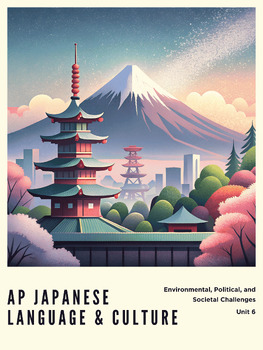
What does a nation's response to climate change reveal about its values? When young people refuse to wear painful shoes to work, what is really being challenged? How does immigration reshape a society built on cultural homogeneity? What happens when a natural disaster exposes systemic inequality? This unit doesn't just teach vocabulary about contemporary challenges. It asks students to understand the complex, interconnected crises facing Japan today—environmental degradation, political disengagement, immigration pressures, gender inequality, public health disparities—and what Japan's responses reveal about cultural priorities, power dynamics, and possibilities for change.
See it on Teachers Pay Teachers — $24.99
Students explore six critical dimensions reshaping Japan: environmental issues (carbon neutrality, climate risks, natural disasters), political participation (low youth engagement, grassroots activism), immigration and labor (demographic crisis, integration challenges), gender inequality (#KuToo movement, women's leadership), public health (mental health, work-life balance, social safety nets), and interconnected global challenges. They analyze real case studies (Fukushima disaster response, #KuToo activism), debate policy solutions, and develop informed perspectives on how societies address systemic problems—moving beyond simplistic "problems vs. solutions" to ask deeper questions: Who holds power? Whose voices are heard?
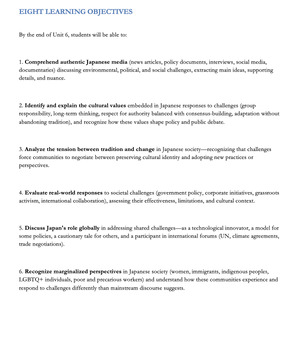
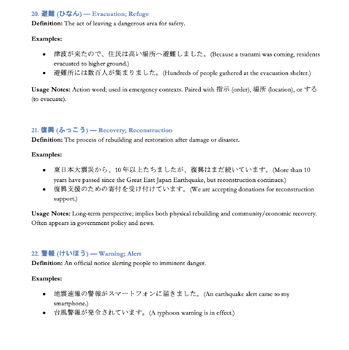
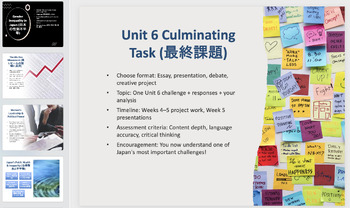
What must change? What resistance exists? Complete, exam-aligned Unit 6 curriculum for AP Japanese Language and Culture. The final unit of the 6-unit bundle, or anexcellent standalone. PEDAGOGICAL APPROACH Deeply analytical, never oversimplified — Authentic examination of societal challenges as systemic, interconnected, and tied to power structures; explores both barriers and real change-makers Authentic language progression — Build sophisticated register and policy/activism vocabulary (環境問題, 気候変動, 政治参加, 多様性, 格差, 社会運動) through analysis of real challenges and responses Stratified scaffolding — Challenge overview case study debate assessment progression builds confidence across all proficiency levels while maintaining rigor Critical thinking emphasis — Students analyze WHY problems persist, WHO benefits from status quo, HOW change happens (or doesn't), and WHAT they would do differently—developing agency and nuanced thinking Flexible pacing — 4–6 week unit (14–18 fifty-minute periods or 10–12 block periods); extensions for advanced learners; differentiation for ELL and developing readers All three modes — Interpretive (listening/reading), Interpersonal (debate/discussion), and Presentational (writing/speaking) communication throughout unit; emphasis on argumentation and persuasion PERFECT FOR AP Japanese Language and Culture (all proficiency levels, grades 11–12) Teachers seeking culturally grounded, contemporary materials that don't shy from difficult topics Classes exploring activism, social movements, and how individuals create change Classrooms wanting a unit that builds speaking confidence through structured debate Teachers who want everything ready to teach—nothing left to create Students preparing for the AP exam's cultural perspective and persuasive speaking components WHAT'S INCLUDED Pacing guide — 4–6 week lesson plans with daily timing; flexible scheduling for 50-min and block periods; materials lists Vocabulary glossary — 80–100 terms across 7 themed families (environment, politics, immigration, gender, health, activism, systemic change), each with definition, 2–3 example sentences, cultural context notes 10 discussion prompts — Organized by challenge area, with deepening follow-up questions, anticipated responses at multiple proficiency levels, and facilitation tips for sensitive topics Midpoint assessments — Both listening (2 passages with full transcripts, 5 questions each) AND reading (350-word article, 6 questions) with complete answer keys and scoring guidance 2 detailed case studies — Fukushima Disaster Response (real emergency management + inequality exposed) and #KuToo Movement (gender activism + cultural change), each with 4–6 follow-up discussion/writing activities Presentational writing task — Full prompt, specifications (300–350 words in Japanese), detailed rubric (5 dimensions, 50 points), planning worksheet, and 3 annotated student sample responses Structured debate activity — 4-role debate format (policy proponent, skeptic, affected community voice, facilitator) with preparation materials, argument frames, and 30-point rubric Presentational speaking task — 3–5 minute persuasive presentation on one challenge + proposed solution, with 30-point rubric and sample student scripts Teacher's notes — 4 common misconceptions with pedagogical strategies, 5 facilitation moves for discussing divisive topics, differentiation for ELL/advanced/developing learners, 10 extension activities, answer keys, troubleshooting Slideshow — 28 slides with speaker notes, professional design (charcoal/teal color scheme), image placeholders for Fukushima, activists, policy infographics All answer keys and scoring rubrics — Ready to assess student work immediately COMPONENTS INCLUDED Unit Overview & Learning Framework Slideshow (28 slides with speaker notes) Glossary (80–100 vocabulary words, 7 families) Pacing Guide (4–6 week lesson plans, 50-min + block schedules) Opening Activity (challenge ranking brainstorm—10–15 min hook) Discussion Prompts (10 critical thinking questions by challenge) Midpoint Assessments (listening + reading, both with keys) Cultural Case Study 1 (Fukushima disaster response) Cultural Case Study 2 (#KuToo gender activism movement) Debate Activity (structured 4-role policy debate with rubric) Presentational Speaking & Writing Tasks (persuasive speaking + essay, rubrics) Teacher's Notes (answer keys, facilitation strategies, differentiation, extensions) KEY FEATURES Real activism, real change — Features actual movements (#KuToo) and watershed events (Fukushima) that illustrate how societies respond to crisis and injustice Debate as pedagogy — Structured debate format teaches persuasive Japanese, builds confidence, and develops ability to argue respectfully across disagreement—exam-aligned communication skill Dual assessment options — Both listening AND reading midpoint assessments; both writing AND speaking summative assessments ensure all learners can demonstrate proficiency Sensitive topics handled with care — Disaster, gender discrimination, mental health, immigration prejudice presented respectfully; includes explicit facilitation guidance for difficult conversations Interconnected analysis — Slide 25 explicitly teaches how challenges connect (e.g., aging society labor shortage immigration pressure gender dynamics); students see systems, not silos Global perspective — Unit 6 asks how Japan's challenges compare to other nations; positions Japan in world context while honoring its unique situation No TPT branding on student materials — Professional, uncluttered aesthetic throughout Designed for exam rigor AND critical citizenship — Develops proficiency AND helps students think like informed global citizens UNIT 6 THEMES Environmental Challenges: Carbon neutrality goals, climate risk, natural disasters, Fukushima's ongoing legacy Political Participation:
Youth disengagement, voter turnout, grassroots activism, democratic participation Immigration & Labor: Aging population crisis, labor shortages, integration challenges, xenophobia Gender Inequality: Pay gaps, domestic labor, #KuToo (high heels workplace mandate), women in leadership Public Health: Mental health stigma and awareness, work-life balance, social safety nets, inequality in healthcare access Interconnected Change: How activism, policy, and individual choices create systemic transformation Sensitive content included: This unit addresses real crises (Fukushima disaster, gender discrimination, suicide, immigration prejudice).
Facilitation guidance provided. No graphic imagery, but topics require emotional maturity and respectful handling. All assessments provide opportunities for students to show proficiency across listening, reading, writing, and speaking—essential for AP exam success. Designed for Intermediate-High to Advanced proficiency (ACTFL standards) but includes differentiation strategies for all levels. Keywords: AP Japanese, contemporary issues, environmental challenges, political activism, gender equality, #KuToo, Fukushima, case studies, debate, persuasive writing, speaking rubrics, systemic change, critical thinking, complete curriculum, ready to teach
Designed for grades 11–12.
 Starmaker English and Journalism Tools
Leave a comment