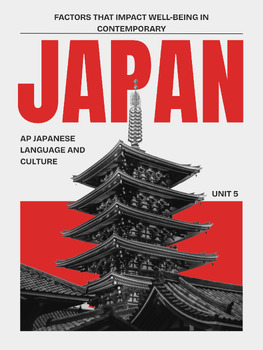
What happens when a nation prioritizes exam excellence over student mental health? What choices does a society make when work culture leads to death from overwork? What are we gaining—and losing—when we sacrifice personal well-being for economic stability?
See it on Teachers Pay Teachers — $24.99
This unit doesn't just teach vocabulary about quality of life. It asks students to understand the values driving a society, the trade-offs inherent in how nations prioritize well-being, and what quality-of-life choices reveal about cultural priorities. Students explore how six interconnected dimensions shape quality of life in Japan:
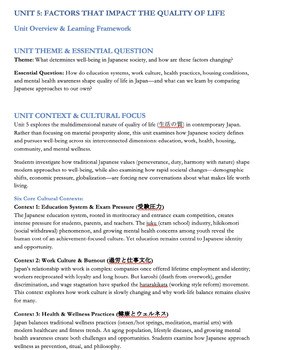
education system pressure, work culture and burnout, health and wellness practices, housing and living conditions, urban versus rural life, and mental health awareness. They analyze case studies of real people, debate ethical dilemmas around work-life balance, and develop nuanced perspectives on well-being—moving beyond stereotypes to ask harder questions: Why does Japan make these choices?
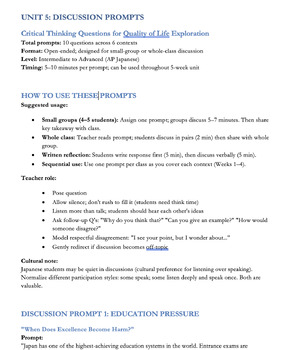
What are the costs and benefits? How do different cultures define a "good life"? Complete, exam-aligned Unit 5 curriculum for AP Japanese Language and Culture.
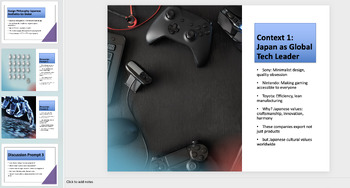
Perfect as a standalone unit OR as part of the 6-unit bundle. PEDAGOGICAL APPROACH Deeply analytical, never oversimplified — Authentic examination of quality of life as cultural choice, systemic trade-offs, and real human experiences Authentic language progression — Build register control and sophisticated vocabulary (社会問題, ストレス, ワークライフバランス, メンタルヘルス) through discussion of societal challenges Stratified scaffolding — Context introduction discussion assessment progression builds confidence and ensures accessibility for all proficiency levels Critical thinking emphasis — Students analyze WHY Japan prioritizes certain factors in quality of life and what those priorities reveal about cultural values and societal tensions Flexible pacing — Week-by-week breakdown; extensions for advanced learners; differentiation for ELL and developing readers; suitable for traditional and block schedules All three modes — Interpretive (listening/reading), Interpersonal (discussion), and Presentational (writing/speaking) communication throughout unit PERFECT FOR AP Japanese Language and Culture (all proficiency levels, grades 11–12) Teachers seeking culturally grounded, standards-aligned materials on contemporary issues Classes exploring ethics, social systems, and cultural values through language Classrooms wanting a complete 5-week unit with built-in assessments, rubrics, and teacher support Teachers who want everything ready to teach—nothing left to create WHAT'S INCLUDED Pacing guide — Week-by-week lesson plans (5 weeks, 15–20 periods); daily timing; materials list Vocabulary glossary — 80–100 terms across 7 themed families (quality of life general, education, work, health/wellness, housing, mental health, social change), each with definition, 2–3 example sentences, cultural context 10 discussion prompts — Organized by cultural context, with deepening follow-up questions, anticipated student responses at multiple proficiency levels, and facilitation tips Midpoint assessment — Reading comprehension task (authentic-style article on work-life balance, 390 words) with 6 questions (multiple choice, select-all-that-apply, inference) and complete answer key with scoring guidance 2 case studies — Hikikomori narrative (social withdrawal; 3-page story of real person's crisis and recovery) and quality-of-life factors mini-profiles, each with 4–6 follow-up discussion questions Presentational writing task — Full prompt, specifications (260–310 words in Japanese), detailed rubric (4 dimensions, 50 points), planning worksheet, and sample student responses with scoring annotations Communication activities — Two options: Small-group discussion (life priorities trade-offs) and personal perspective presentation (4–5 min on one quality-of-life factor), each with detailed rubrics Teacher's notes — 3 common misconceptions with strategies, 5 facilitation moves, differentiation for ELL/advanced/developing learners, 8 extension activities, answer keys, and troubleshooting guide Slideshow outline — 26–29 slide structure with speaker notes, professional design direction (images, data visualization, discussion starters) All answer keys and scoring guides — Ready to assess student work immediately FILE FORMATS Word document — All 11 components, professionally formatted with table of contents and page breaks PowerPoint slideshow —28-slide introduction to the unit Ready for immediate classroom use — Fully editable; just download and teach COMPONENTS INCLUDED Unit Overview & Learning Framework Slideshow Outline (28 slides) Glossary (80–100 vocabulary words, 7 families) Pacing Guide (week-by-week lesson plans) Opening Activity (life priorities brainstorm—10–15 min hook) Discussion Prompts (10 critical thinking questions) Midpoint Assessment (reading comprehension + answer key) Cultural Case Study (hikikomori narrative + discussion guide) Presentational Writing Task (essay prompt, rubric, worksheet) Communication Activity (discussion & presentation options) Teacher's Notes (answer keys, tips, extensions, differentiation) KEY FEATURES Authentic case study — Real human narrative (Misaki's hikikomori experience and recovery) builds empathy and cultural understanding Culturally rigorous — Six quality-of-life dimensions reflect how Japanese society actually prioritizes well-being; includes contemporary issues (exam pressure, karoshi/overwork deaths, rural depopulation, mental health stigma) Assessment across all modes — Students show proficiency through reading, speaking (discussion & presentation), writing, and listening Sensitive topics handled thoughtfully — Mental health, suicide, work stress presented with care; includes facilitation guidance for difficult conversations No branding on student materials — Professional, uncluttered aesthetic throughout Designed for exam rigor AND critical thinking — Not just test prep; develops cultural analysis and perspective-taking skills Flexible, teacher-friendly — Use components individually or as a complete unit; adapt pacing to your calendar NOTES This is Unit 5 of a 6-unit AP Japanese curriculum.
Designed for grades 11–12.


Leave a comment