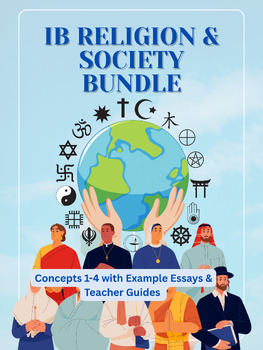
Covers Concepts 1–4 (CHANGE, IDENTITY, INTERPRETATION, POWER) This comprehensive bundle contains four concept guides for the IB Diploma Programme Religion and Society course (launching August 2027) and the current IB World Religions program. Each guide is fully developed with real-world examples, detailed teacher guides, and essay models. Concept 1: CHANGE (15 pages) Theme 1.1: Responses & Adaptations to Change (Vatican II, digital fatwas in Indonesian Islam, Engaged Buddhism). Theme 1.2: Attempts to Affect Change in Society (Civil Rights Movement, interfaith climate justice, Myanmar pro-democracy monks). Includes full example essay on Vatican II with teacher's guide explaining IB command terms. Practice questions with answer scaffolding. Concept 2: IDENTITY (12 pages) Theme 2.1: Identity Within Religious Communities (Hajj and Islamic ummah, Shabbat and Bar Mitzvah, Christian denominationalism). Theme 2.2: Identity in Relation to Others (Sikh turban activism, Jewish diaspora politics, Buddhist secularization in the West). Includes example essay on Hajj with detailed teacher guide.
See it on Teachers Pay Teachers — $24.99
Practice questions with outline structure. Concept 3: INTERPRETATION (17 pages) Theme 3.1: Interpretation of Texts & Narratives (Torah and Talmudic debate, Quranic tafsir and Islamic jurisprudence, Christian scripture wars). Theme 3.2: Interpretation of the World Around Us (evolution vs. creationism, liberation theology, environmental stewardship). Full example essay on Islamic jurisprudence showing how multiple valid interpretations emerge from a single sacred text. Extensive teacher's guide with student pitfall analysis. Concept 4: POWER (17 pages) Theme 4.1: Power Within Religious Communities (Catholic hierarchy and Vatican II tensions, Islamic imam authority in diaspora, Buddhist sangha democratization). Theme 4.2: Relations with Political Powers (Christian nationalism in US politics, Islamic governance models, religious persecution in China). Includes detailed example essay on separation of religious and political authority with teacher's guide addressing IB rubrics.
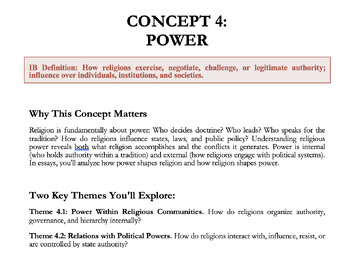
Total: 57 pages across 4 downloadable and editable Word documents. What Each Concept Guide Contains IB-aligned concept definition Why this concept matters (teacher-friendly context) Two themes, each with 3 contemporary real-world examples (2020–2025) How to apply in your essay (with IB command terms explained) Fully developed example essay showing strong IB writing Teacher's guide to the example essay (command term breakdown, pitfall analysis, rubric alignment) Short-response and essay practice questions with outline scaffolding Ready to print or share digitally; no institutional branding Works with TWO IB Curricula! Current: IB World Religions (through May 2028) Use these guides immediately for any IB World Religions course. The four concepts are embedded in the current syllabus. Guides work for Paper 1 and Paper 2 preparation, exam practice, unit introductions, homework, and independent study across all traditions. Upcoming: IB Religion and Society (August 2027 onwards, first assessment May 2029) The International Baccalaureate is redesigning its World Religions course, renaming it "Religion and Society" with expanded focus on how religion shapes and is shaped by society. The four core concepts—CHANGE, IDENTITY, INTERPRETATION, and POWER—are central to this new syllabus. These guides directly prepare students for the new course structure and assessment. Early adoption teachers have ready-to-use, concept-aligned curriculum resources from day one. Future-Proof Investment: Whether you're teaching current World Religions or piloting the new Religion and Society program, this bundle covers both curricula. No rewrites needed when the new course launches.
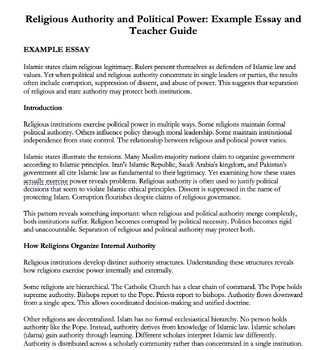
Your investment works now and continues to work for years to come. For Teachers Ready to teach immediately. Print and distribute, or email as PDFs. No prep required. Example essays model IB writing. Show students how strong responses tackle command terms (explain, analyse, discuss, evaluate). Teacher guides explain the writing. Break down how each essay demonstrates IB command language. Identify common student pitfalls. Align with IB assessment rubrics. Practice questions scaffold essay writing. Short-response questions build confidence before full essays. Outline prompts provide structure for beginning writers. Specific, current examples. Every case study is grounded in 2020–2025 events.
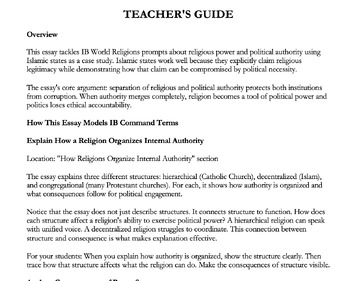
Not generic definitions. Real cases students recognize and can analyze. Humanized, professional tone. No AI-sounding language. Clear teacher voice. Conversational and direct. For Students Learn each concept deeply. Two themes per concept mean understanding from multiple angles. See what strong writing looks like. Full example essays show how to structure responses using IB command terms. Build essay skills progressively. Start with short responses, move to outline prompts, then full essays. Understand exam expectations. "How to Apply" sections translate IB command language into what teachers expect. Work with relevant examples.
Real cases from recent years feel meaningful, not distant or historical.
Designed for grades 9th – 12th.


Leave a comment