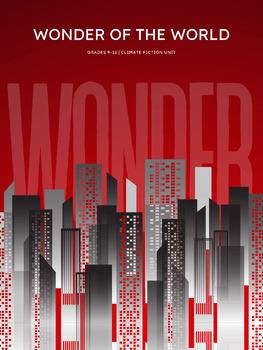
"Wonder of the World" is a climate fiction story about Ben, a 15-year-old who builds a Morse code communication device from salvaged electronics. When a nor'easter threatens his community, the Device Network becomes essential. On Winter Solstice, Ben sends a global message: OSO (Over. Start Over). It comes back as FHL: Faith.
See it on Teachers Pay Teachers — $16.99
Hope. Love. The story matters because it centers young people leading, not waiting to be rescued. Jess, Ben's mother, grieves what the climate crisis has taken. Ben sees it as an opportunity. Together, they model something we don't see often in climate fiction: an intergenerational conversation where both perspectives matter.
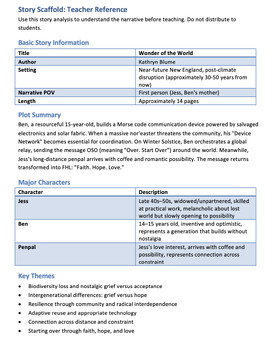
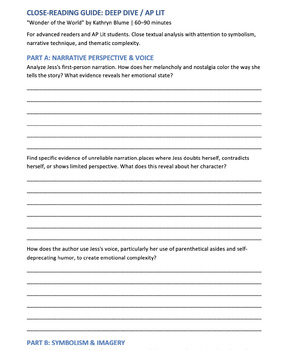
What you get: Student materials (all printable, no school branding): Three close-reading guides differentiated by level (Quick Survey, Moderate Dive, Deep Dive/AP Lit) Reading comprehension quiz with answer key Discussion protocol with hinge questions, analytical prompts, and real synthesis work Three writing prompt options (analytical essay, creative exchange, personal reflection) Climate Connection Activity with four research pathways (phenology, biodiversity, food systems, ecosystem services) Activist Pathways organized in four tiers, from personal action to systemic change Teacher materials: Facilitation guide with three pacing options (1-day, 3-day, 5-7 day unit) Story analysis with plot, characters, themes, symbols, and discussion anchors Assessment rubrics for every assignment Differentiation strategies for ELL, advanced readers, struggling readers, neurodivergent students, and students facing economic barriers CCSS standards alignment spelled out Teach it in one period or stretch it across a week. Pick your close-reading level or let students choose. Assign one writing prompt or both. Modify the discussion or use it as written.
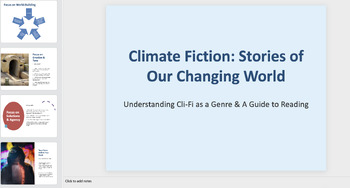
Mix and match based on what your class needs. Unlike most climate fiction, this story doesn't end in collapse. It asks what happens when young people actually get to lead, what adaptation can mean, and whether starting over is possible. High school students who worry about climate change respond to that. They want evidence that meaningful action is real. Works as a standalone unit or as part of a larger climate fiction, environmental literature, or dystopian fiction sequence. Grades 9–12 in English, Literature, Environmental Studies, and Social Studies.
Grade Level: Grades 9–12 Time Required: 1 day to 5–7 days (your choice) Story Source: From Everything Change: An Anthology of Climate Fiction (free at climateimagination.asu.edu) Standards: CCSS Reading Literature (RL.1–7), Writing (W.1–3), Speaking & Listening (SL.1–6)
Designed for grades 9–12.


Leave a comment