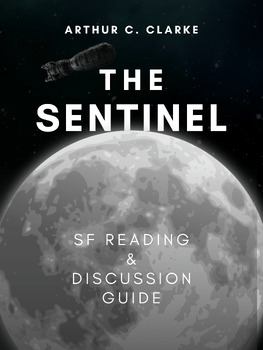
Arthur C. Clarke builds this story on real lunar geology and expedition logistics — and that scientific precision is exactly what makes the alien artifact feel possible. When the geologist finds a pyramid on the Moon that is clearly not natural, the reader believes it. Clarke then stops at the moment of implication rather than showing the consequence. That restraint is one of the best moves in the genre.
See it on Teachers Pay Teachers — $3.50
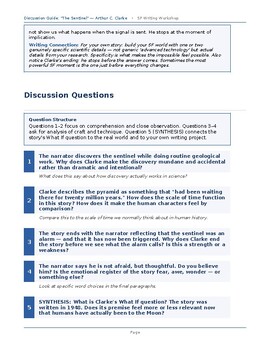
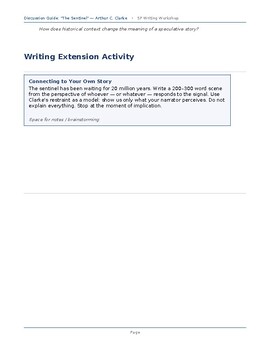
The craft focus is scientific grounding and the restrained revelation — two techniques students can actually use in their own writing. This is a good early-unit story, especially when students are building their own worlds and need to consider what makes invented details feel real. What's Included: Author context — Clarke's place in hard SF and the story's connection to 2001: A Space Odyssey Key vocabulary — 5 terms with definitions Craft analysis — scientific grounding and restrained revelation, with a direct writing connection 5 discussion questions with teaching prompts — tiered from comprehension to craft to application Writing extension — students write the scene from the perspective of whatever answers the signal Teacher notes How to Use It:
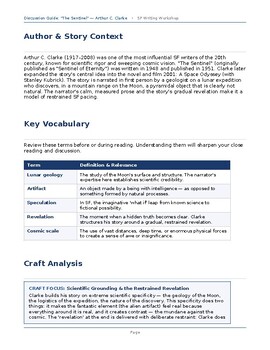
Works as a standalone lesson or as an early anchor in a multi-story workshop sequence. The 2001 connection gives teachers a familiar entry point for students who haven't read the story. Difficulty: accessible. Strong choice for world-building discussions.
Grades 9–12. Story Text: Not included — "The Sentinel" is copyrighted. It appears in most SF anthologies, through school library databases, and on Archive.org(as "Sentinel of Eternity"). This guide is one of six mentor text resources in the Science Fiction Short Story Writing Workshop — Complete Unit Bundle, which includes the student writing packet and teacher slide deck.
Buying the bundle saves you significantly over purchasing the guides separately. If this resource saved you prep time, please leave a rating under My Purchases Provide Feedback. Every review earns you TpT Credits toward future purchases — roughly $1 in credits for every $10 reviewed. Follow Starmaker English & Journalism Tools to be notified when new resources launch or go on sale. Keywords:
The Sentinel, Arthur C. Clarke, 2001 A Space Odyssey, science fiction short story, SF writing workshop, high school ELA, reading discussion guide, hard science fiction, world-building, scientific grounding, craft analysis, close reading, grades 9-12, science fiction literature, short story lesson
Designed for grades 9–12.


Leave a comment