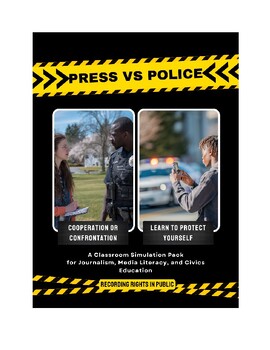
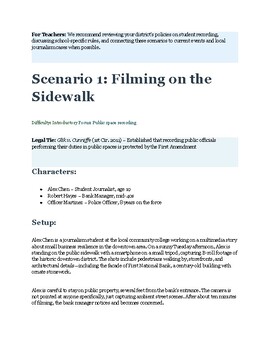
Perfect for Journalism, Civics, Media Literacy & Government Classes | Grades 9-12 Help your students navigate one of the most relevant constitutional issues of our time with this comprehensive, print-ready simulation 5-pack exploring recording rights, First Amendment protections, and the complex intersection of press freedom, police accountability, privacy law, and public safety. What's Included in This 57-Page Resource: Five Complete Role-Play Scenarios with Expanded Dialogue: Filming on the Sidewalk (Public Forum Rights & Police Encounters) Filming Inside the Coffee Shop (Private Property vs. Free Expression) Undercover in the Locker Room (Privacy, Consent & Journalistic Ethics) The Traffic Stop (Recording Police & Reasonable Distance) Filming a School Incident (Student Press Rights vs. School Authority) Each scenario features 2-3 pages of realistic, classroom-appropriate dialogue that brings constitutional questions to life, plus thought-provoking discussion questions designed to spark meaningful debate. Student-Facing Materials: Legal disclaimer with ACLU and Freedom Forum resources Quick reference guide: "Your Right to Record" chart State-by-state recording law overview Mini legal glossary with key terms Real court case connections (Glik v.
See it on Teachers Pay Teachers — $8.76
Cunniffe, Turner v. Driver, Tinker v. Des Moines) Separate Teacher Reference Section (Keep for Yourself!): Complete legal background for each scenario Supreme Court and Circuit Court case summaries Discussion question guidance with suggested answers Classroom management tips for sensitive topics Teaching strategies for role-play activities Extension activities and assessment options Additional resources from ACLU, Student Press Law Center, Freedom Forum Cross-curricular connections (History, Government, Ethics, Technology) Why Teachers Love This Resource: Immediately Engaging – Students are fascinated by viral video controversies, police accountability debates, and social media conflicts. These scenarios tap into issues they care about. Legally Accurate – Based on real Supreme Court and Circuit Court precedents, with proper citations and current legal standards (updated for 2025). No Right Answers – Scenarios are deliberately nuanced to encourage critical thinking, not rote memorization. Perfect for Socratic discussion and debate.
Print & Go Ready – Professionally formatted with clear page breaks. Print pages 1-32 for students, keep pages 33-57 for teacher reference. Flexible Implementation – Use as a week-long unit, single-day workshop, debate preparation, mock trial foundation, or current events connection. Standards Aligned – Supports civics standards on constitutional rights, government curriculum on First Amendment, journalism education on press law, and media literacy frameworks. Perfect For: Journalism Classes – Essential training on recording rights, privacy law, and ethical boundaries Civics/Government – First Amendment application, public forum doctrine, state vs. federal law Media Literacy – Citizen journalism, verification, ethics of recording and publication Law/Mock Trial – Constitutional law simulation, case analysis, legal reasoning practice Current Events – Connect to viral video controversies and police accountability debates Debate/Speech – Complex topics with multiple legitimate perspectives Learning Objectives Students will: Distinguish between public forums and private property for First Amendment purposes Explain when recording police is constitutionally protected (and when it's not) Analyze the difference between recording and interfering with law enforcement Compare student press rights to professional journalist protections Evaluate privacy expectations in different locations Apply Supreme Court precedents to real-world scenarios Consider tactical vs. principled approaches to asserting constitutional rights Discuss how power, privilege, and identity affect rights enforcement What Makes This Different:
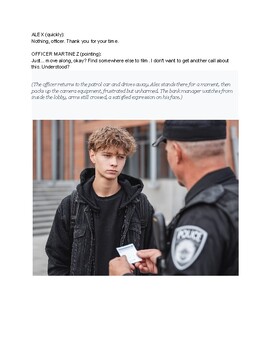
Unlike simple worksheets or generic Supreme Court case studies, this simulation pack features five fully-developed dramatic scenarios with authentic dialogue, realistic escalation, and consequences that students can debate. The expanded scripts (not just bullet points!) allow for genuine role-play that brings constitutional questions off the page and into lived experience. The separate teacher section means you can facilitate informed discussion without "giving away the answers" – students engage with scenarios first, then you guide them toward legal and ethical understanding using the comprehensive background provided. Includes Important Legal Disclaimer: The resource emphasizes that recording laws vary by state and circumstance, encouraging students to: Check local laws before recording Consult ACLU resources for state-specific guidance Reference Student Press Law Center and Freedom Forum for journalism protections Understand one-party vs. all-party consent states Respect privacy even when recording is legal This simulation is part of the Complete High School Journalism Curriculum Bundle — 69 resources covering a full year of journalism instruction, including ethics, press freedom, writing, photography, and assessment tools. If this resource saved you prep time, please leave a rating under My Purchases Provide Feedback. Every review earns you TpT Credits toward future purchases — roughly $1 in credits for every $10 reviewed.
Follow Starmaker English & Journalism Tools to be notified when new resources launch or go on sale. File Details: 57 pages total (32 student pages + 25 teacher reference pages) PDF format – Print or digital use Professional layout with clear headers, discussion boxes, and case citations No prep required – Everything you need is included Topics Covered: First Amendment, press freedom, recording rights, public forum doctrine, private property rights, reasonable expectation of privacy, student speech rights, Tinker standard, recording police, police accountability, citizen journalism, journalistic ethics, privacy law, consent laws, trespass, qualified immunity, substantial disruption, FERPA, Glik v. Cunniffe, Turner v. Driver, Tinker v. Des Moines, Hazelwood v. Kuhlmeier, constitutional rights, civil liberties, media law
Designed for grades 9-12.
 Starmaker English and Journalism Tools
Leave a comment