
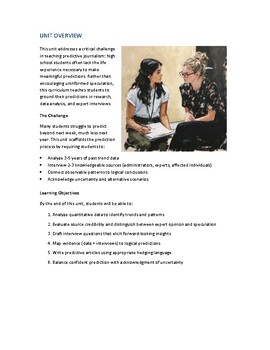
Most high school students can tell you what they think will happen. Getting them to prove it is the harder skill. This unit teaches evidence-based forecasting — students analyze trend data, conduct expert interviews, and write 600–1,200 word predictive articles that could run in a real publication. No speculation allowed; every claim needs a source behind it.
See it on Teachers Pay Teachers — $13.59
What's Included: Complete daily lesson plans for a 2–3 week unit — day-by-day instruction with timing, 45-minute frameworks, opening hooks, teacher scripts, and discussion questions Student materials — topic selection tools, the Predictability Checker, research collection templates, evidence mapping graphic organizers, interview planning guides, draft writing templates, peer review protocols, and self-assessment checklists Professional mentor texts — annotated examples from real publications with discussion guides and an "what makes this effective?" annotation framework Assessment tools — research checkpoint rubric, interview quality checklist, evidence mapping self-assessment, draft evaluation worksheets, and a comprehensive 100-point final article rubric Teacher support — pacing guide, standards alignment documentation, answer keys, conference note templates, common student challenges with solutions, and differentiation strategies for struggling students, advanced learners, and ELL students Four extension activities — prediction accountability check-in, point/counterpoint paired predictions, multimedia prediction package, and cross-curricular applications What Makes This Unit Different: The Predictability Checker is the key tool — it helps students assess whether their topic is actually forecastable before they invest time researching it. Students then organize evidence into four quadrants:
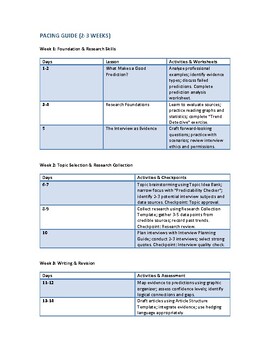
past data, current signals, expert voices, and logic/reasoning. The unit also teaches hedging language explicitly, so students learn to express confidence proportional to evidence strength rather than overstating or understating their claims. How to Use It: Follow the complete 2–3 week sequence for a full unit, condense to one week by focusing core lessons and assigning research as homework, or pull individual components — the mentor text analysis, evidence mapping tools, or interview protocols — to enhance existing curriculum.
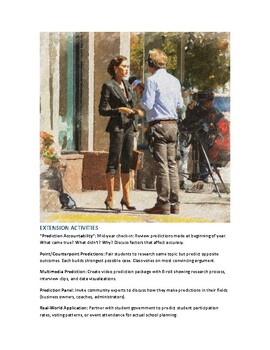
Strong fit for journalism, ELA research writing, media literacy, and cross-curricular project-based learning in science, history, and economics. This unit is part of the Complete High School Journalism Curriculum Bundle — 69 resources covering a full year of journalism instruction at significant savings. If this resource saved you prep time, please leave a rating under My Purchases Provide Feedback. Every review earns you TpT Credits toward future purchases — roughly $1 in credits for every $10 reviewed.
Follow Starmaker English & Journalism Tools to be notified when new resources launch or go on sale. Keywords: predictions journalism unit, evidence-based journalism, predictive writing high school, journalism research unit grades 9-12, forecasting journalism lesson, journalism unit 2-3 weeks, analytical journalism high school, journalism research and writing, data journalism classroom, journalism trend analysis, journalism critical thinking unit, journalism ELA research writing, evidence mapping journalism, predictive article writing, high school journalism complete unit
Designed for grades 9-12.
 Starmaker English and Journalism Tools
Leave a comment