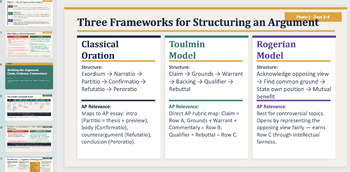
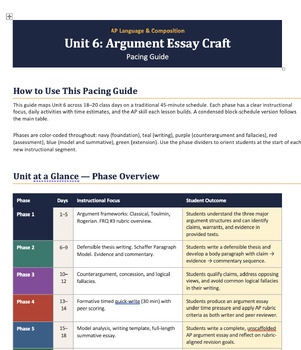
FRQ #3 trips students up for a predictable reason: they know what an argument is, but they don't know what the AP rubric is actually asking them to do. This unit fixes that. Students learn where most essays lose points — a thesis that describes instead of argues, body paragraphs that quote without explaining, a counterargument section that attacks a strawman — and they get enough structured practice to stop making those mistakes under timed conditions. Eighteen to twenty days across six phases, from argument frameworks and rubric introduction through a full unscaffolded summative essay scored on the official Row A / Row B / Row C rubric. What's Included (11 resources): 23-Slide PowerPoint — The three argument frameworks (Classical Oration, Toulmin, Rogerian), FRQ #3 rubric introduction, defensible thesis writing, the Schaffer Paragraph Model, evidence vs. commentary, warrants, logical fallacies, counterargument and concession moves, all four Row C sophistication pathways, and the 40-minute exam process. Includes a 5/6 annotated model essay, a complete scoring breakdown from 1/6 to 6/6, all five speed-dating argument prompts, and a full unit vocabulary reference. 18–20 Day Pacing Guide — Six phases: What Is an Argument (Days 1–5), Building the Argument (Days 6–9), Counterargument and Fallacies (Days 10–12), Formative Assessment (Days 13–14), Model Analysis and Summative Essay (Days 15–18), and Optional Socratic Circle Extension (Days 19–20). Includes a 10-day compressed version, a block schedule adaptation, and a post-AP-exam option.
See it on Teachers Pay Teachers — $16.99
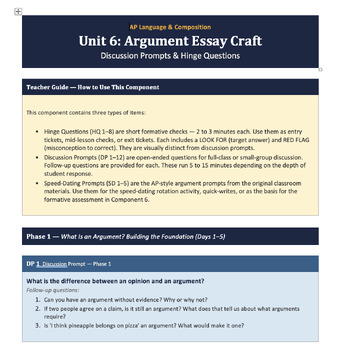
30-Term Glossary — Six sections covering foundations, argument structures, building the argument, counterargument, logical fallacies, and the three appeals. Every entry includes a definition, a concrete example, and an AP Relevance note for terms that directly affect rubric scoring. Self-check table at the end so students track which terms they can define vs. actually use in writing. Opening Activity — Three-part Day 1 sequence: claim ranking, the Claim Spectrum, and a diagnostic quick-write using the Horace adversity prompt. Students rank four thesis statements from weakest to strongest before any direct instruction, giving teachers a baseline on where the class is before Phase 2 begins. Discussion Prompts and Hinge Questions — Eight hinge question cards, each with a target answer and a flagged misconception to address. Twelve discussion prompts across all five instructional phases. All five speed-dating prompts (Tuchman, Horace, Boorstin, public opinion, incentivized charity) formatted as AP-style cards with source citations, passage text, and task directions. Formative Assessment — Two-day timed argument quick-write using the Boorstin dissent vs. disagreement prompt.
Day 13: prompt annotation, position selection, thesis planning, evidence outlining, pre-write self-check. Day 14: 30-minute timed write followed by peer scoring on the official AP rubric, with a writer's reflection on whether they agree with the score they received. Annotated Model Essay — A complete argument essay responding to the Boorstin prompt, written to score 5/6, with eight annotation types throughout: Row A thesis, Line of Reasoning, Evidence, Commentary, Warrant, Counterargument, Concession and Rebuttal, and Row C sophistication. The path from 5/6 to 6/6 is identified specifically. Seven analysis questions and a Steal the Move reflection prompt. Essay Writing Template — Schaffer Model reference table for all eight sentence positions, Commentary vs. Summary comparison table, single-paragraph practice scaffold for Days 7–8, full essay planning scaffold with color-coded sections, 32 essay lines for the summative, pre-submission checklist, and a Row C self-assessment that asks students to name the specific sophistication move they used. Teacher Notes — Five common student struggles with specific fixes: vague thesis, evidence without commentary, list vs.
line of reasoning, strawperson counterargument, and Row C paralysis. A 20-point summative rubric with AP scale conversion. Day-by-day Schaffer Model facilitation guide for Days 7–9 with suggested teacher scripts. Speed-dating logistics for classes of 20–35 with three timing variants. Extension Activities — Socratic Circle Debate (written position prep, observer notes form, full debrief sequence), Fallacy Hunt (ten real-style argument excerpts with answer key and rewrite challenge), and Argument Relay (groups of three build a complete essay one sentence per turn, constraints force the claim-evidence-commentary chain). Unit Overview and Learning Objectives — Phase-by-phase breakdown mapped to AP skills 3.A, 3.B, 4.A, 4.B, 5.A, 6.A, 4.C, and 3.C. Plain-language explanation of how the FRQ #3 rubric works, including what Row C is actually asking and why most student essays don't earn it. The Argument Relay is the activity teachers don't expect to work as well as it does. Groups of three building a complete essay one sentence per turn — with constraints that prevent anyone from skipping the commentary — forces students to feel the claim-evidence-commentary chain rather than just label it on someone else's writing. The fallacy hunt and Socratic circle round out a unit that has more structured practice volume than any other in the series. College Board alignment is built around FRQ #3 using the official Row A / Row B / Row C rubric, AP-style prompts drawn from real exam materials, and the authentic Boorstin passage. All materials are editable Word documents and PowerPoint — no school branding on student-facing pages.
This is Unit 6 of a complete, nine-unit AP Language and Composition curriculum. It builds on Unit 5: Synthesis Essay Essentials and leads into Unit 7: Grammar, Mechanics, and Style. The complete course is available as the AP Language and Composition Complete 9-Unit Curriculum Bundle at over 30% off individual unit prices. If this resource saved you prep time, please leave a rating under My Purchases Provide Feedback. Every review earns you TpT Credits toward future purchases — roughly $1 in credits for every $10 reviewed. Follow Starmaker English & Journalism Tools to be notified when new resources launch or go on sale. Keywords: AP Language and Composition, AP Lang Unit 6, argument essay, FRQ 3, FRQ prep, Toulmin argument, Rogerian argument, Schaffer paragraph model, Row C sophistication, AP Lang curriculum, College Board aligned, AP exam prep, high school ELA, argument writing, secondary English
Designed for grades 9th – 12th.


Leave a comment