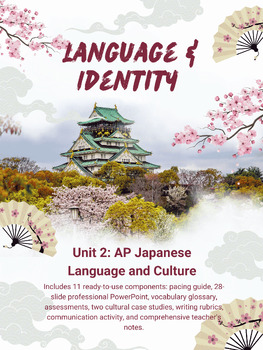
Why does a Tokyo marketing manager speak formal Japanese at work but slip into her hometown Hiroshima dialect when she calls her parents? And why do young Ainu learners spend hours mastering a language that almost no one speaks anymore? This unit doesn't just teach keigo and dialects—it asks your students to understand how language is identity, how code-switching reveals cultural values, and what we lose when languages disappear. Complete, exam-aligned Unit 2 curriculum for AP Japanese Language and Culture (or high school Japanese 4). Includes 11 ready-to-use components: pacing guide, 28-slide professional PowerPoint, vocabulary glossary, assessments, two cultural case studies, writing rubrics, communication activity, and comprehensive teacher's notes.
See it on Teachers Pay Teachers — $24.99
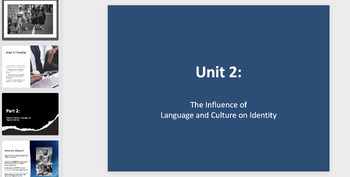
WHAT'S INCLUDED: Pacing guide with 14–15 class periods broken down by day (Week 1: Keigo & politeness levels | Week 2: Regional dialects & code-switching | Week 3: Minority languages & final projects) 28-slide professional PowerPoint: keigo system explained, dialect pride, code-switching in daily life, Ainu language preservation, vocabulary preview, assessment overview Comprehensive glossary with 68 vocabulary items organized by situation (keigo terminology, workplace/formal, home/casual, dialect, code-switching, minority languages—not random lists, but real communicative contexts) Opening activity (15-min hook:
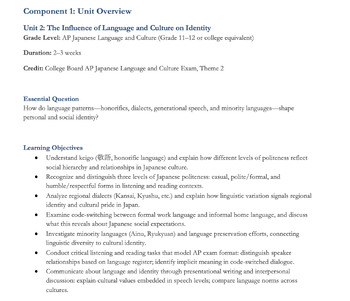
"Language Snapshot—How Do You Switch?") 10 tiered discussion prompts (comprehension analysis personal reflection) Two midpoint assessments: Listening (8 questions on register-shifting + answer key) and Reading (10 questions on code-switching & cultural change + answer key) Two detailed cultural case studies with discussion guides: — Ainu Language Preservationist: An educator fighting to revive an endangered indigenous language (9 reflection questions) — Code-Switching Across Contexts: A working mother navigating Hiroshima dialect at home, standard Japanese at work, casual speech with friends (9 reflection questions) Presentational writing task (4 topic options) + 4-point rubric with 5 dimensions Communication activity (dialogue roleplay: boss call colleague chat family call, showing register-shifting in real time) + rubric with scoring guide Extensive teacher's notes:
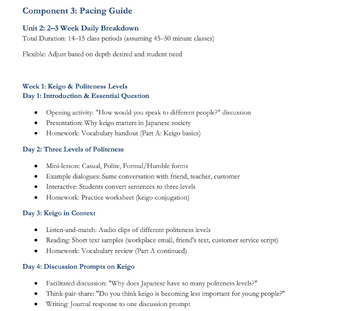
answer keys for both assessments, vocabulary recommendations, extensions for advanced learners, scaffolds for struggling learners, connections to Units 1 and 3–6 PEDAGOGICAL APPROACH: Deeply cultural, never stereotyping—respectful examination of real tensions in modern Japan: young people vs. keigo tradition, dialects vs. standardization, language preservation vs. globalization Content spans formality systems to identity:
keigo's role in hierarchy regional dialects as markers of belonging code-switching as cultural sophistication endangered languages and what's at stake Keigo-heavy (6 dedicated slides + vocabulary section + assessment items): recognizing that honorific language is the single most testable aspect of this theme on the AP exam Tiered questioning: comprehension (What does keigo do?) analysis (Why does Japanese have keigo but English doesn't?) application (How do you code-switch in your own life?) scaffolds critical thinking Exam-aligned: models AP listening (register recognition), reading (inference from cultural text), presentational writing (perspective on cultural topic), and interpersonal communication (dialogue with appropriate politeness) Flexible pacing: 14–15 class periods (adjust for 45-min or 90-min blocks) PERFECT FOR: AP Japanese Language and Culture (all proficiency levels, grades 10–12) High school Japanese 4+ courses Teachers seeking culturally grounded, not tourist-level content Classes exploring identity, language, social hierarchy, and cultural change Teachers building a complete 6-unit curriculum (see Unit 1 for structure) NOTES:
This is Unit 2 of a 6-unit curriculum (Units 1–6 sold separately or as bundle) No store branding on any materials—clean, professional, editable design All documents are in Garamond, 1-inch margins, print-ready Answer keys and rubrics included; ready for immediate classroom use
Designed for grades 10–12.


Leave a comment